Mandatory re-ident process → 4-5× monthly completion
ux research
product design
fintech
2024
So what's the problem?
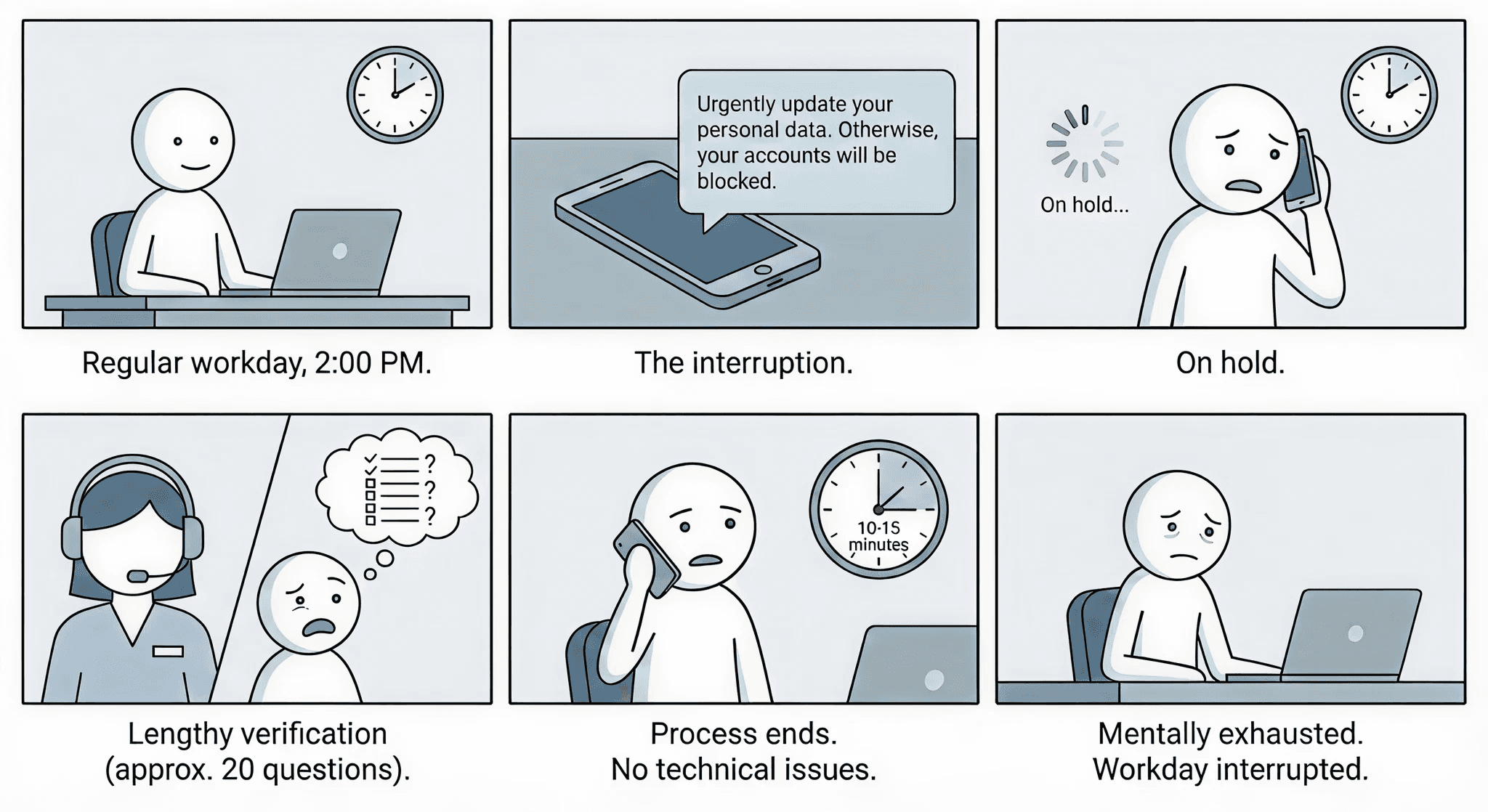
Imagine it’s 2:00 PM.
You’re in the middle of a regular workday when a text from your bank arrives: “Urgently update your personal data. Otherwise, your accounts will be blocked.” You call the number from the message, spend a few minutes on hold and eventually reach an operator who confirms that your data indeed needs to be updated.
The update itself happens over the phone. You’re asked a series of questions (~20). The conversation takes 7-10 minutes and ends without incident. Nothing technically goes wrong, but the process is demanding enough to interrupt your day. This is often the starting point for people when re-identification introduced.
What’s re-identification?
It’s a mandatory process where a bank periodically asks clients to review and confirm their personal data to meet regulatory and risk requirements. From the bank’s side it’s routine compliance; from the user’s side it often appears without warning and offers little value beyond keeping their account operational.
The environment this lives in
This work sits inside a highly regulated banking product where data accuracy isn’t a “nice to have.” It’s required for compliance, for risk management and for basic operational safety. At the same time, documents and personal information are emotionally loaded and the moment a bank asks for updates, people start scanning for intent:
Why now? What changed? What happens if I don’t?
The tricky part wasn’t regulation. It was how it landed on people.
Risks
Compliance
Clarity
My scope
My job wasn’t to simplify regulations or negotiate requirements away. What I could change was the experience: how we explain the request, how much effort it feels like and whether people believe the bank is acting with intent. The goal was simple to describe and hard to execute: help clients complete a mandatory process independently, without calls, branch visits or the sense they’re being pushed into something unclear.
Moreover, moving re-identification into the app took a big chunk of routine work off branches and the call center. That gave those teams space to focus on the work they’re actually measured on, instead of spending hours on repetitive compliance updates.
Before
Around ~11.5k completions per month
MVP — what shipped first
The first version wasn’t built to be elegant. It was built to make re-identification possible without branches or phone calls.
MVP CJM
That meant three things:
Fully digital self-service flow, so people could finish the process on their own schedule instead of negotiating time with support.
Questionnaire that covered every required field and question needed for compliance, even when some of it felt heavy or repetitive from a user point of view.
Simple notification trigger that clearly told users “this needs to be done”.
At this stage, the goal was functional compliance — not experience quality.
MVP design
After launch — what I noticed
Once the MVP was live, the pattern was consistent: people could complete the flow, but many didn’t understand the intent behind it and the experience often felt bigger than it needed to be.
“I don’t want to read legal documents to understand why the bank requires this. Explain it in a simpler, more understandable way. I’m not familiar with bureaucracy.”
– Clients' feedback
The questionnaire itself amplified that feeling, especially in places where users were asked to manually enter information the bank already had, which made the effort feel unjustified. Tone didn’t help either: legal language and consequence-focused phrasing made the process read as threatening rather than supportive, even when the actual steps were straightforward.
“Why do I need to enter all this information from scratch? It takes a lot of time. The bank should already know this about me. Make it simpler!”
– Clients' feedback
In reality, drop-offs weren’t evenly spread. They clustered around steps where the effort felt least explained and the value least visible. Support requests stayed higher than expected because many users still needed reassurance while going through something that was technically “self-service.”
“What’s the difference between ‘confirmed’ and ‘additional’ income? If I have documents for my additional income, where should I put it?”
– Clients' feedback
MVP
Around ~25-35k completions per month
Fixes — what I changed iteratively
I didn’t try to remove mandatory steps. Instead, I treated the real issue as cognitive and emotional load and focused on reducing both without compromising compliance.
I rewrote the “why” in plain language. I moved away from generic legal phrasing and explained what’s happening, why it’s needed and what users should expect next.
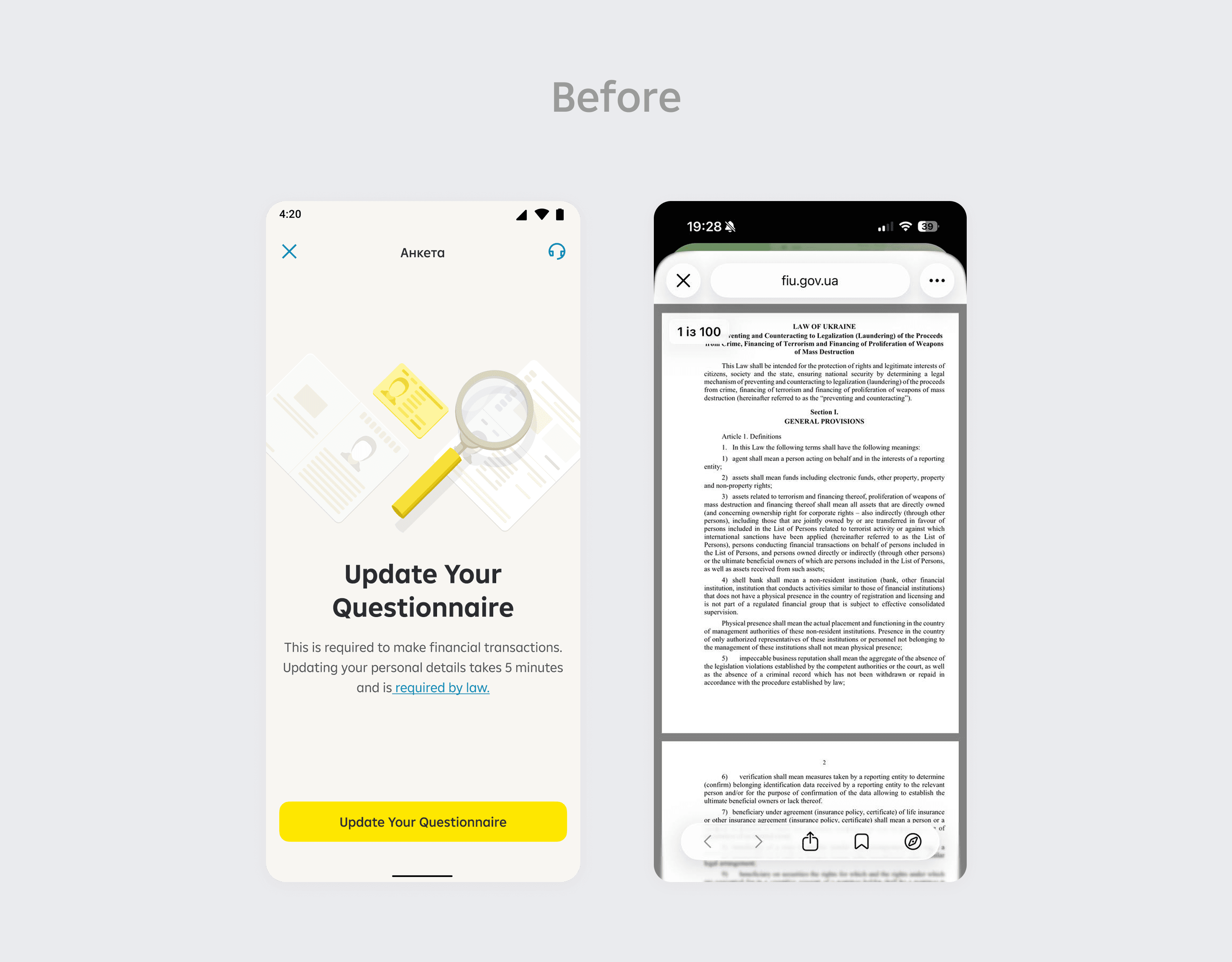
Before. A direct link to the law made users feel like we were shifting responsibility onto them — basically saying, “go figure it out yourself.”
After. We added an interactive, story-like explanation of why keeping personal data up to date matters, so the request lands more clearly and users understand what’s happening before they start.
I shifted from re-entry to review. Wherever possible, we auto-prefilled known data and let users confirm or edit it instead of typing everything from scratch.
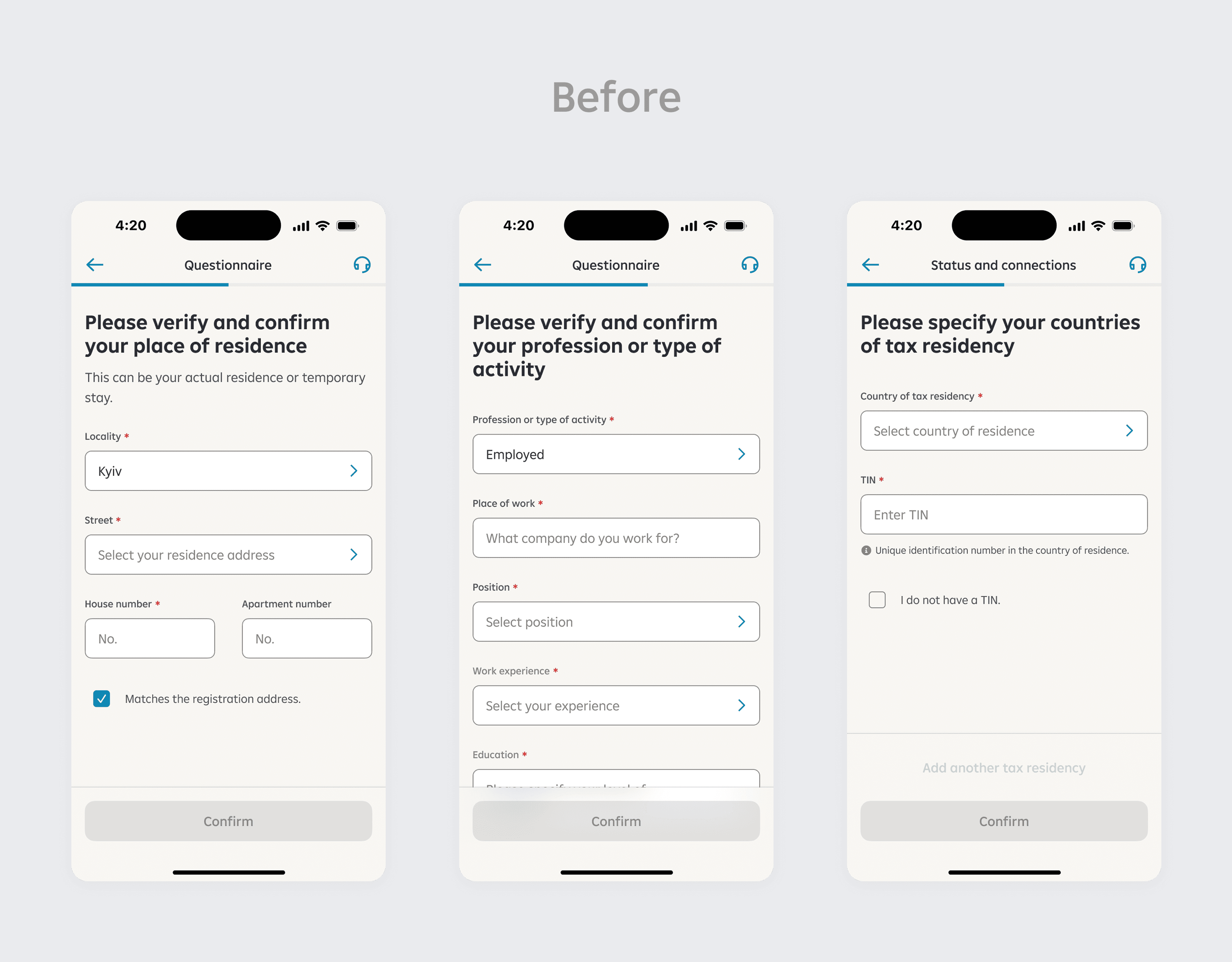
Before. Empty fields forced people to re-type information the bank already had. That unnecessary effort became one of the biggest friction points in the flow.
After. Users only needed to review and confirm their details and we refined the UI with better-fit controls based on usability testing.
I added explanations where drop-offs clustered. Instead of changing the overall structure, I introduced short, just-in-time guidance in the steps that caused the most hesitation, clarifying what’s being asked and why.
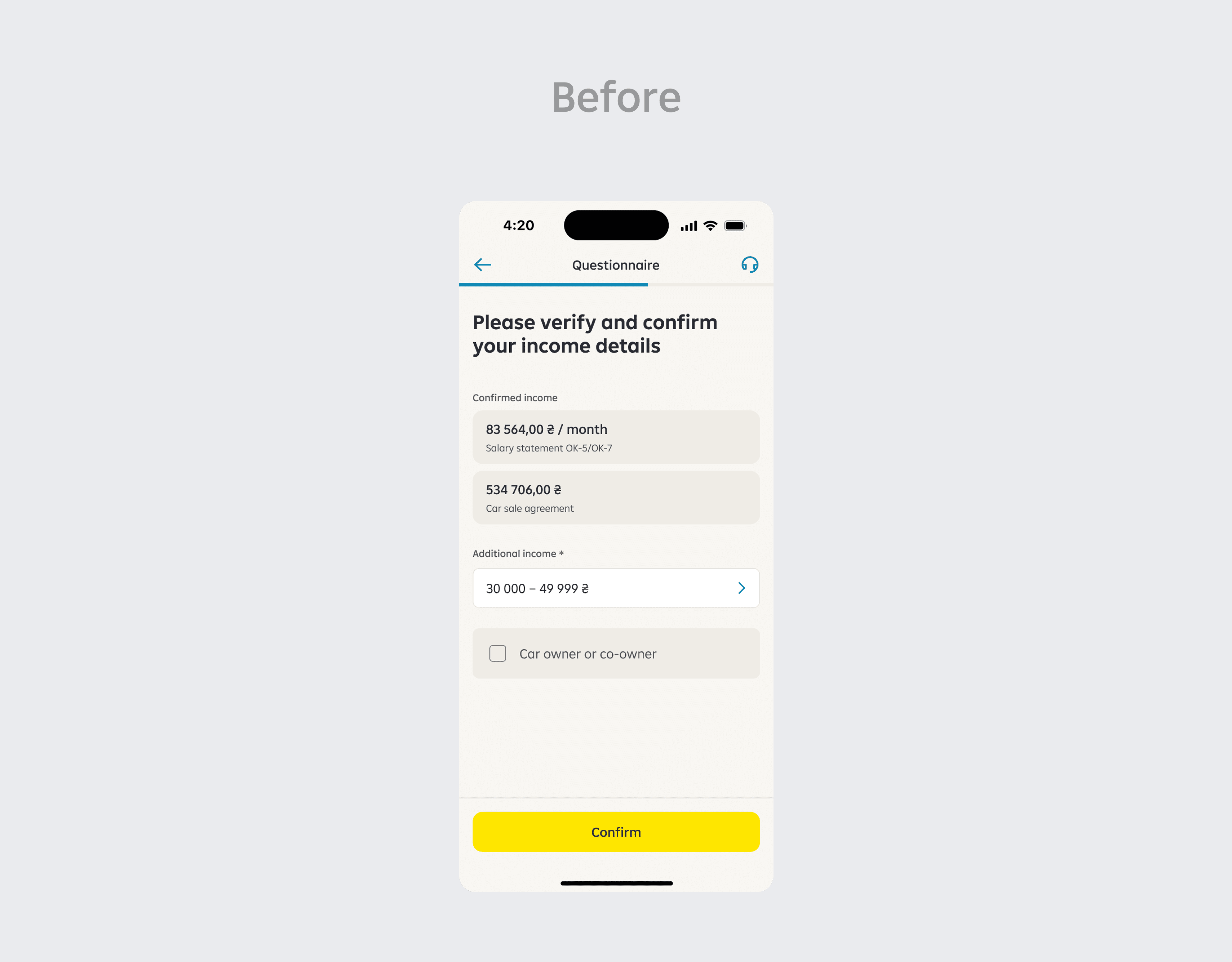
Before. Users didn’t understand the difference between confirmed and additional income. The layout made it worse — grouping and emphasis didn’t match how people scanned the page.
After. We added clear explanations to each section and regrouped the content so it followed a more natural, scannable structure.
I reduced pressure in messaging. I softened the language in notifications and in-flow messaging, expanded the communication window and aligned push, SMS and in-app copy.
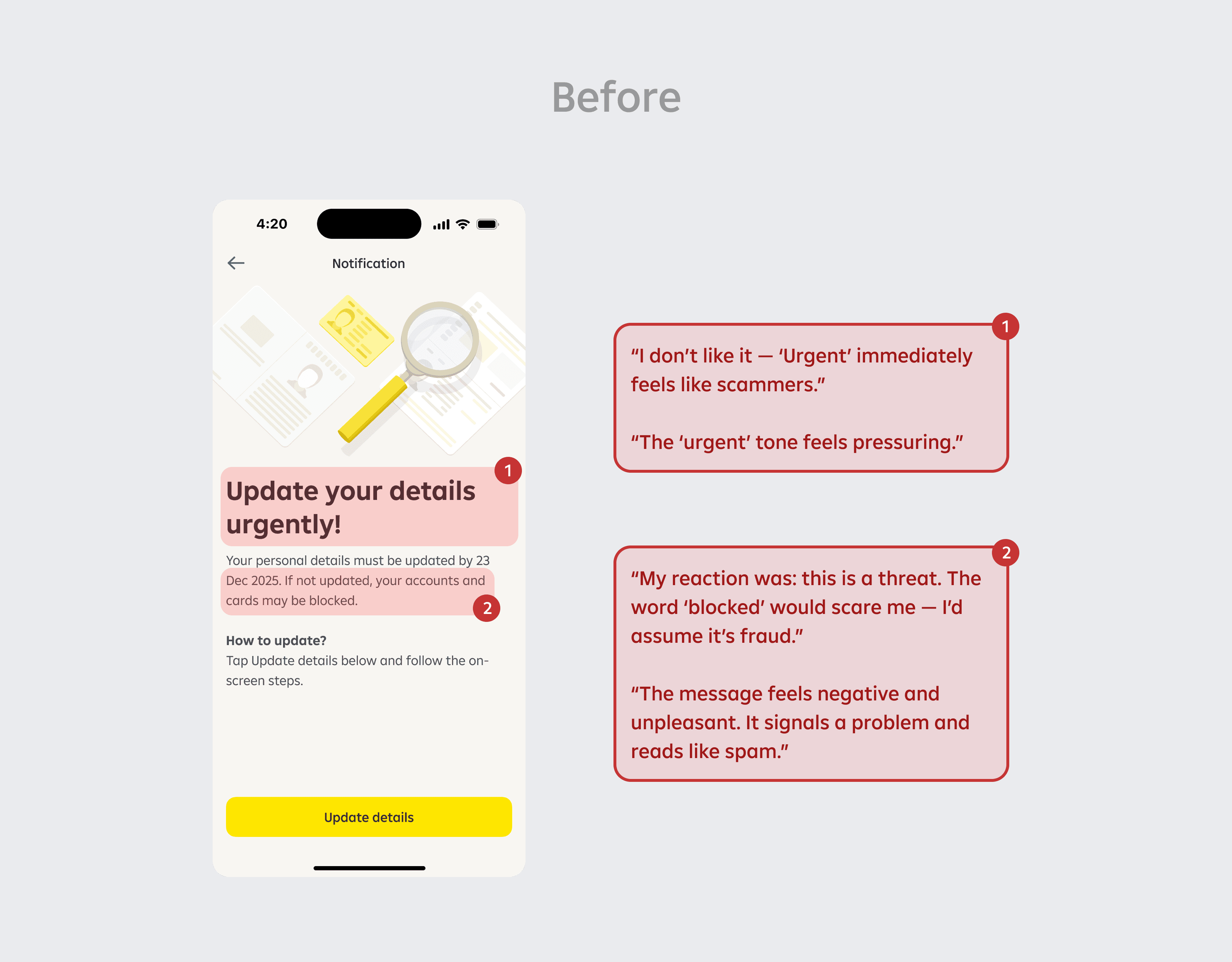
Before. After speaking with users directly, we saw the issue: our messages felt alarming, not helpful. “Urgent” and “blocked” triggered fraud associations and hesitation instead of clear action.
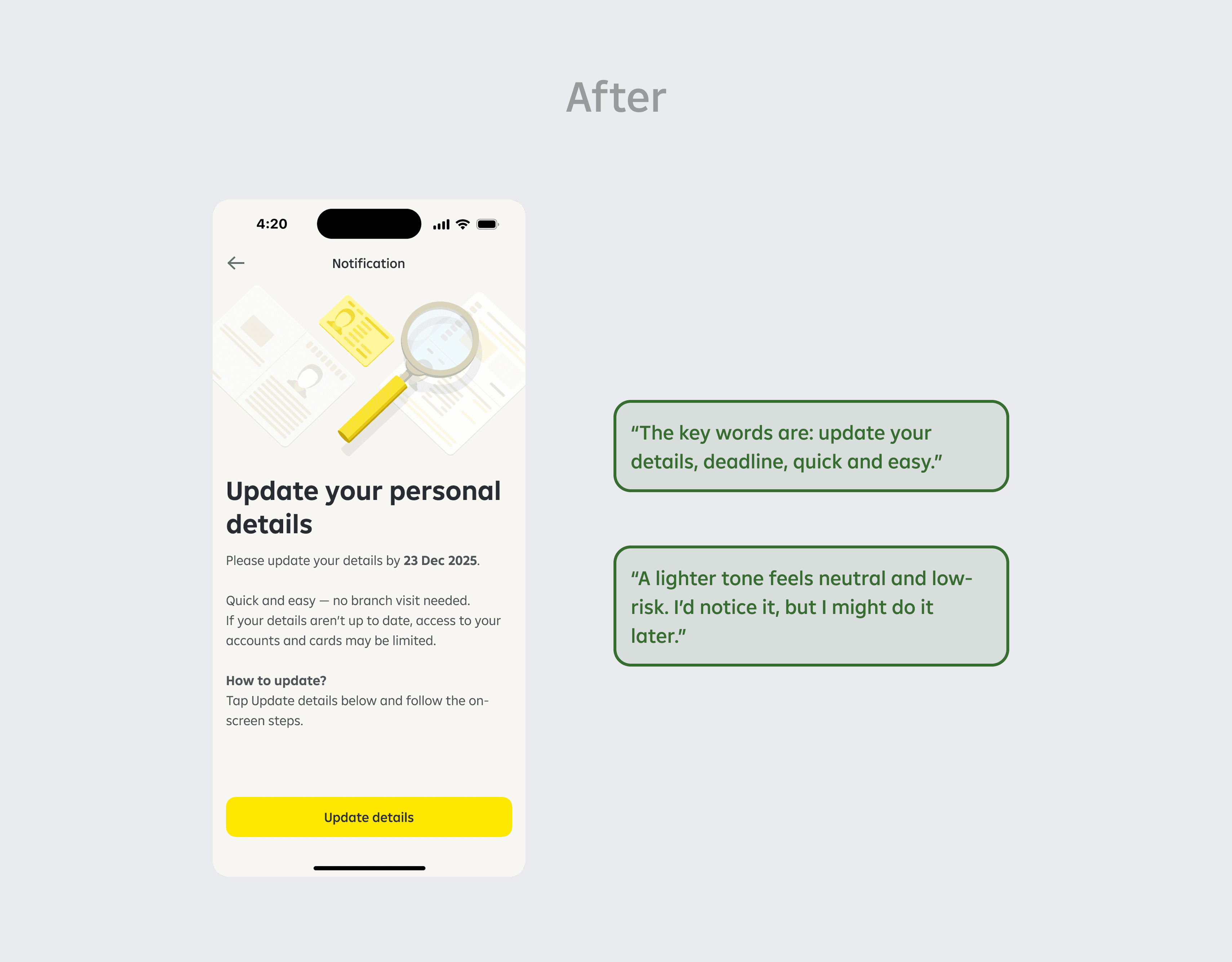
After. We moved away from “urgent” messaging and leaned into a more friendly, explanatory tone that feels safer to trust.
In one paragraph
The MVP proved people could complete re-identification end-to-end in the app, but it also showed where trust breaks in mandatory flows: unclear intent, repetitive data entry and messaging that leans on consequences instead of clarity.
After launch I used research (interviews, user tests) and behaviour data to find the steps with the highest hesitation, then iterated around explanation, review-over-reentry and calmer communication that starts earlier and stays consistent across channels. The requirements didn’t change, but the experience became easier to understand and easier to finish without support.
After iterations
What moved
The first iteration was scale.
Once re-identification became available in-app, completions stopped being tied to branches and phone calls. Monthly completions moved from roughly 9–12k/month before the MVP (Apr–May) to 30k+ in the first months after launch, then kept climbing through iterations — reaching 50–55k/month at its peak and stabilizing in that range.
Monthly re-identification completions
The second iteration was quality.
The MVP proved people could complete the flow on their own, but only about half actually did. Iterations didn’t change what was required — they changed how it felt to go through it. As explanations became clearer, pressure in messaging decreased and effort shifted from re-entering data to reviewing it,
end-to-end completion increased from 49.96% to 66.02%.
End-to-end completion (start → successful update)
Notes to self
Mandatory doesn’t mean clarity becomes optional. “Required by law” is rarely an explanation — it tends to trigger worst-case assumptions when the scope and intent aren’t clear. And in compliance flows, the biggest wins often come not from removing steps, but from reducing the moments where users feel “why am I doing this, and why does it feel so heavy?”.
you can find me
uxbydanylo@gmail.com