Reducing drop-offs by 50% in credit approvals
ux research
product design
fintech
2025
Context
Raiffeisen Bank Ukraine was integrating with Diia (Ukraine's government digital services platform) to enable instant document retrieval. Instead of photographing and uploading documents manually, users could share verified government data in seconds. At that point, manual uploads were causing ~40% drop-offs in the flow, directly limiting credit issuance and scoring coverage.
The business logic was simple: remove friction, retrieve more documents, improve model confidence, approve more credit.
How credit limit increases work
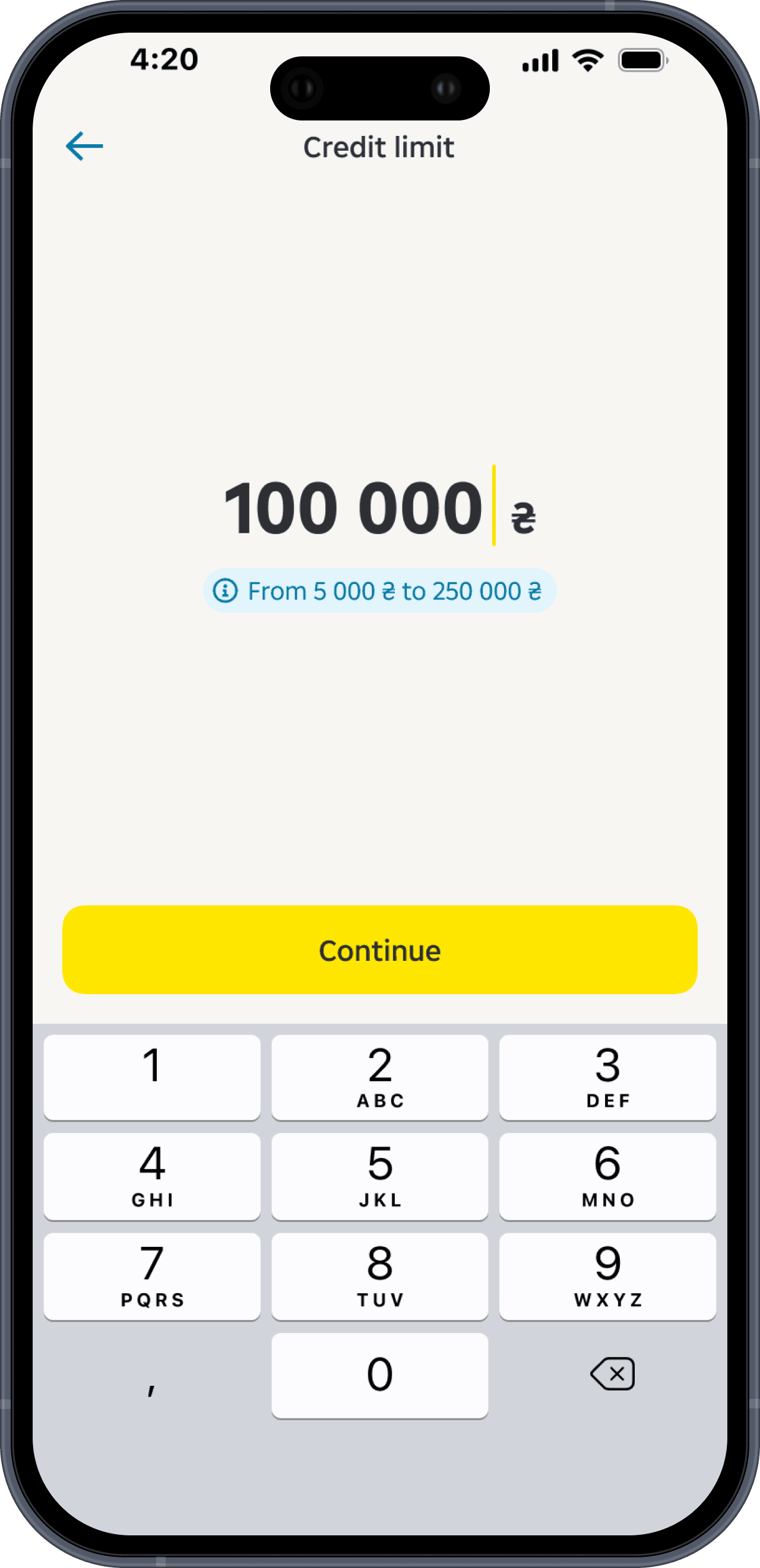
When a user requests a higher credit limit, the bank needs to verify their income to assess repayment capacity. Ukrainian banking regulations require proof of income for limits above a certain threshold — typically an income certificate or tax declaration. This is the moment where document sharing becomes necessary.
Research goals
I led a qualitative study to answer three questions. Do users see real value in sharing documents through Diia and under what conditions? Would they share proactively, before a specific need? And how much does it matter which documents they're sharing — do they want control or do they just want it done?
Users share willingly, but only with a reason
When document sharing was tied to a concrete benefit, people responded positively. The Diia integration itself was seen as a clear upgrade over manual uploads:
"Authorizing through Diia is much faster than photographing, sending and so on."
– Clients' feedback
"If I need to increase my credit limit, then I'll provide documents. But just in advance — no."
– Clients' feedback
The targeted scenario: sharing documents for a specific service like a credit limit increase scored 4.5 out of 5 in Single Usability Metric. The goal was clear, the process was fast, the value was obvious.
Proactive collection triggers resistance
Asking users to share documents "just in case," without a specific task attached, scored significantly lower — 3.5 out of 5. Motivation was unclear and users hesitated:
"For myself, I consider this function unnecessary."
– Clients' feedback on sharing documents in advance
The drop from 4.5 to 3.5 wasn't about friction. Both scenarios used the same Diia integration. The difference was context — whether the ask felt justified.
Control is the dominant concern
The strongest theme across all interviews was control. Users wanted to choose what they share and understand why each document was needed:
"In my opinion, the bank just wants to control me from all sides… That bothers me."
– Clients' feedback
"I believe many of these documents don't affect the credit limit."
– Clients' feedback
"Birth certificate? Education document? I don't understand how that affects my credit limit."
– Clients' feedback
Users weren't rejecting document sharing. They were reacting to over-collection — to feeling like more was being taken than the situation justified.
Competitive benchmarking
I looked at how other Ukrainian financial services handled this:


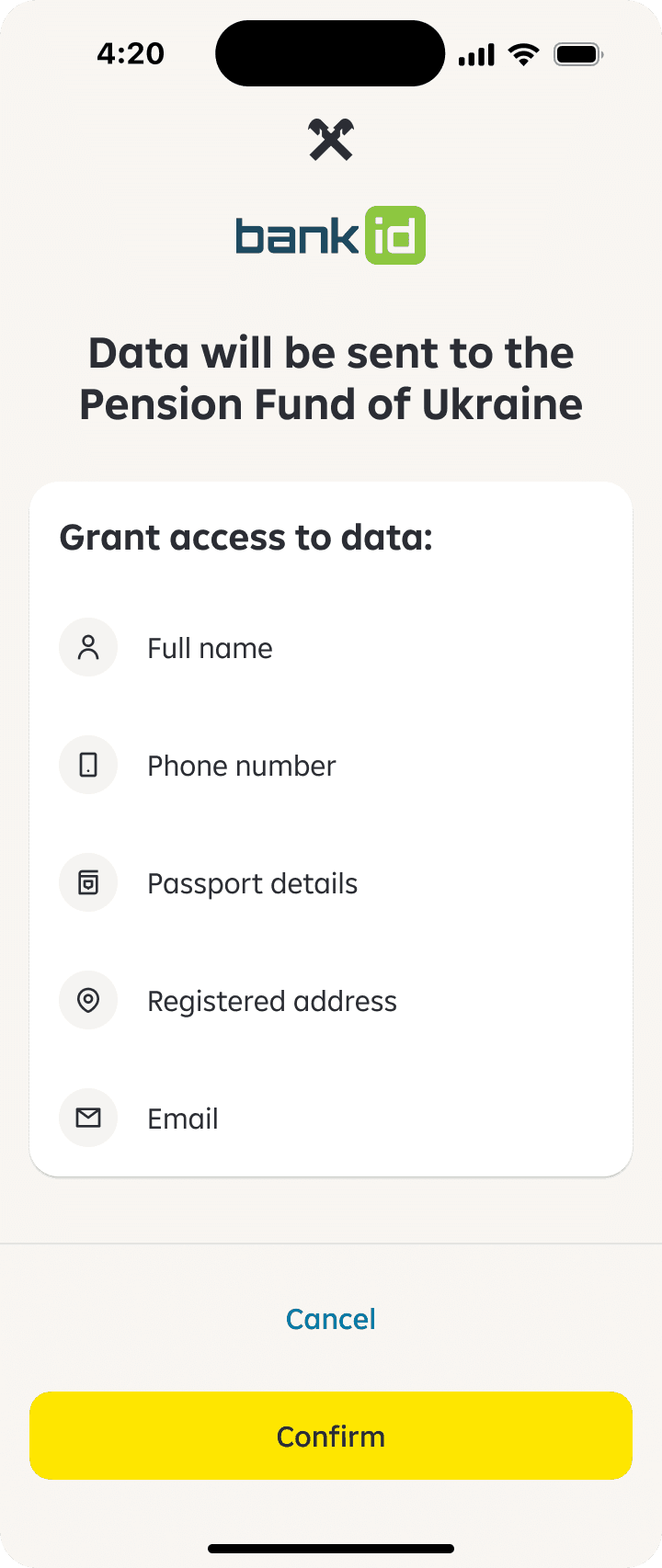

The pattern was consistent: competitors and even the government platform itself practiced restraint.
Progressive profiling principle
Collecting data in small, contextual portions rather than all at once. Industry data supports this: roughly 6 out of 10 customers abandon digital onboarding when it asks for too much information upfront. And GDPR's data minimization principle explicitly requires that collection be adequate, relevant and limited to what's necessary.
The internal debate
Business stakeholders pushed for full automatic retrieval — more signal, less friction, better scores. Manual uploads were losing 4 out of 10 users, so the pressure was real.
I saw it differently. Research showed that over-collection reduces trust and trust directly affects completion. It's not about how risky the process actually is, but how risky it feels to the user.
Rather than debating, I reframed it as a testable hypothesis. That moved the conversation from opinion to experiment.
The A/B experiment
Contextual document sharing with visible choice and explanation will increase completion rates compared to full automatic retrieval.
Primary Hypothesis
I designed two variants using the same Diia integration. Both eliminated manual uploads. The only difference was control and transparency.


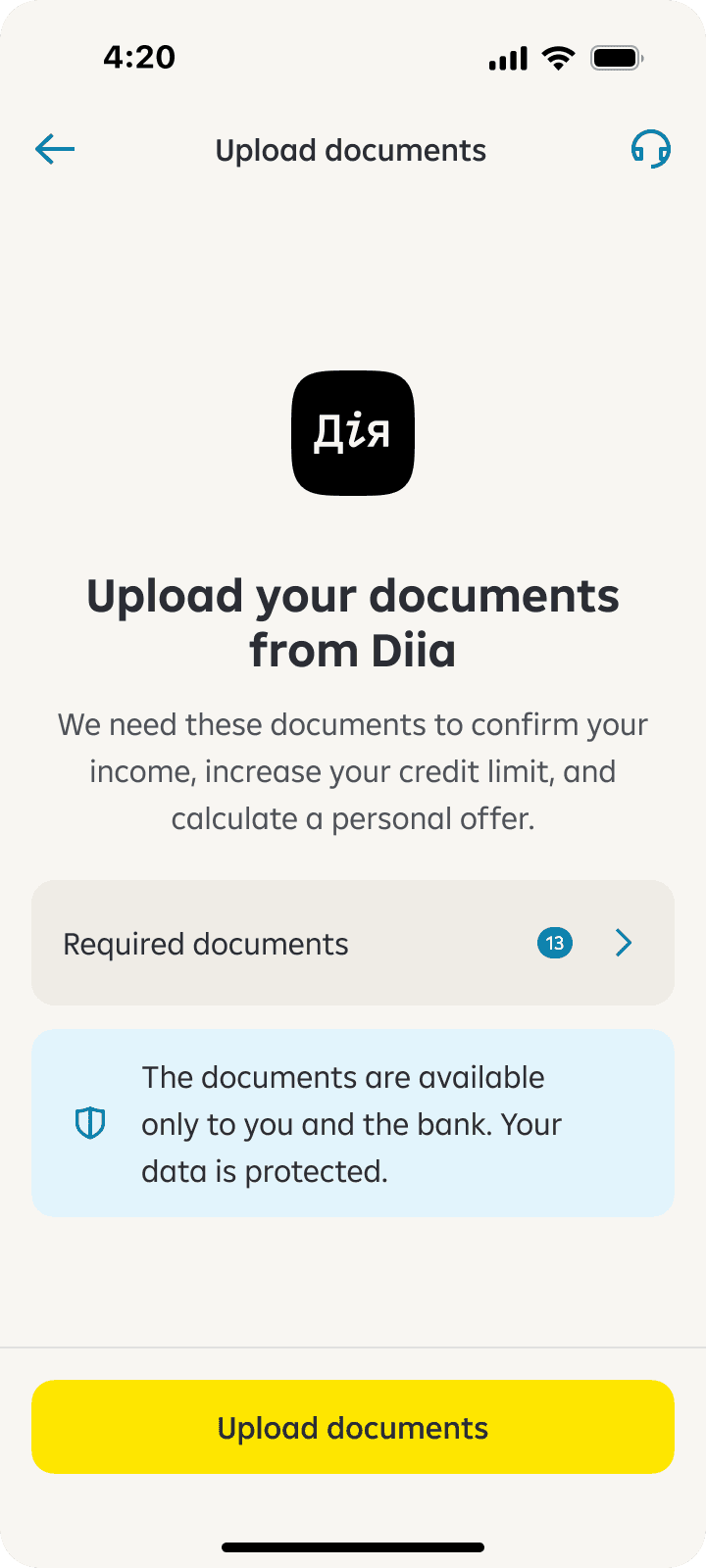
Variant A — Full Automation. All available documents retrieved automatically through Diia. No visible choice. Maximum system confidence.

Variant B — Contextual Sharing. Mandatory documents clearly separated from optional ones. Each document explained. Users explicitly confirm what's being shared.
Results
Both variants outperformed manual uploads, but they weren't equal.
~50%
Fewer drop-offs compared to manual uploads
Variant B consistently outperformed full automation. Users who could see and select their documents were more likely to finish the flow. Support requests asking "why do you need this?" dropped noticeably.
The assumption that maximum automation would maximize conversion didn't hold.
Notes to self
This project shaped how I think about data-rich product environments. Data minimization isn't just a regulatory checkbox — it's a performance lever. Giving users control in high-sensitivity moments doesn't add friction, it reduces perceived risk.
The role I played here wasn't about winning an argument. It was about making the decision process evidence-based — running the research, framing the hypothesis, letting the experiment settle the debate.
you can find me
uxbydanylo@gmail.com